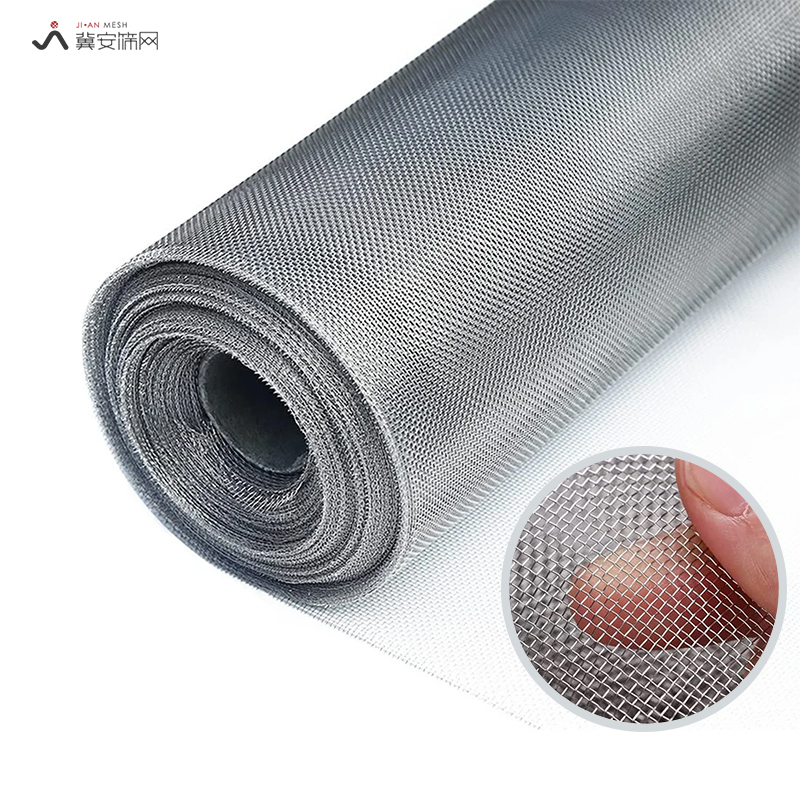
Q: When purchasing filter mesh, why do we need to specify the "Wire Diameter" in addition to the "Mesh Count"?
A: In industrial mesh standards, "Mesh Count" only specifies the number of openings, not their actual size.
1. What is "Mesh Count"?
The precise definition of "100 Mesh" is: exactly 100 openings evenly distributed along a straight length of 1 inch (25.4 mm). As for how thick the "walls" (i.e., wire diameter) separating these openings are, or how large the remaining "windows" (i.e., actual aperture/opening size) are—the unit "Mesh Count" itself does not account for them.
2. A Simple Analogy: Walls and Windows
Imagine a wall that is 25.4 meters long, where you are required to open exactly 100 windows along its length:
If you use thick brick pillars (Thick Wire Diameter): The remaining area left for the window's ventilation/light transmission (aperture) naturally becomes smaller.
If you use ultra-thin iron rods (Thin Wire Diameter): The actual window area (aperture) becomes much larger.
Conclusion: Whether using thick pillars or thin rods, there are exactly 100 windows on this wall, and according to industry standards, both are called "100 Mesh." However, their flow capacity and filtration efficiency are vastly different.
3. Procurement Advice: Always Specify "Dual Parameters"
In industrial mesh procurement, simply asking for "100 mesh screen" is like buying clothes and saying "I want a blue shirt" without specifying the size—it cannot accurately meet your requirements.
Rigorous procurement and technical specifications must adopt a "Dual-Parameter Specification":
Mesh Count + Wire Diameter (e.g., 100 Mesh, 0.15mm Wire Diameter)
OR: Mesh Count + Aperture Size
Only by defining both parameters can you accurately determine whether you need a heavy-duty mesh emphasizing structural strength, or a high-transparency mesh prioritizing filtration efficiency.